How to Preserve Strength When You're Injured
A science-backed way to preserve some strength and muscle during a period of prolonged immobilization or injury.
8/12/20262 min read

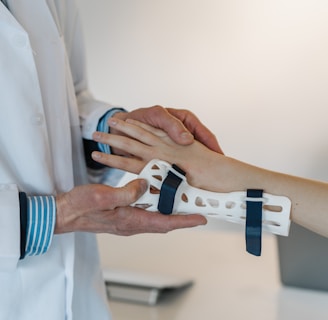
If you've ever broken a bone or needed months to heal from an injury, you know firsthand the frustration of feeling like all your hard-earned progress is slipping away. What many women DON’T know, however, is that they can prevent some of the decline in strength and muscle by doing something that at first seems like woo woo medicine: training the other, uninjured limb.
This strategy is called cross-education, and it's not actually a new concept. It was first described back in 1894, when researchers noticed that strength gains from training one limb transferred, at least partially, to the untrained limb on the opposite side. Over the past 15 years, a group of researchers (notably Justin Andrushko, Jonathan Farthing, and colleagues at the University of Saskatchewan) has turned it into something clinically actionable: a way to protect a limb that's been immobilized by a cast, sling, or brace.
The reason this works is thought to be primarily brain- and nerve-mediated. When you train one limb, that “signal” doesn't stay contained to one side of the brain; there's crossover activation and adaptation on BOTH sides of the central nervous system. So even though the injured limb isn't actually moving, strength and even some muscle fibers may be partially preserved through the training happening on the other side.
The evidence for this has gotten considerably stronger and more precise recently. A 2026 systematic review and meta-analysis in the Journal of Applied Physiology, led by Rodríguez-Coloma and Andrushko, pooled eight controlled studies of one-sided upper-limb immobilization and found that cross-education training of the non-immobilized limb produced a moderate protective effect on strength in the immobilized limb, with a smaller but still significant effect on preserving muscle size.
Earlier studies using participants who used several weeks of arm slings, found consistent sparing of both strength and, in some cases, muscle in the immobilized limb when the opposite arm was trained regularly. And another small study suggested a quicker return to previous strength levels once training resumed, in people who had been training the non-injured limb consistently through their injury.
Of course, this is not a magic bullet and there are always caveats in science. Most trials were small, conducted in healthy volunteers with purposely immobilized limbs (rather than real injuries), and therefore may not translate to older populations, people recovering from actual fractures/surgeries, or people who are not healthy. But it’s worth a try and it certainly won’t worsen your results, and most likely will help. Plus, it might help you mentally so that you still feel you are able to do something to take care of your health and fitness even if you are recuperating from an injury. For people who are used to being active, this can be a major help with the mental burden of prolonged immobility.
So if you're facing a period of immobilization, ask your physical therapist or doctor whether structured resistance training of the uninjured limb, ideally including eccentric work, could be safely added to your recovery plan. It won't replace rehab of the injured side once you're cleared to do that, but it may leave you with less ground to make up when you get there.
Dr. Nicole Rowe - Midlife Metabolic Medicine
© 2026 Nicole Rowe, MD. All rights reserved.
Telemedicine | Women’s Health | Midlife Care